
Soon after graduating the New Zealand School of Dance in 2016, the young Australian dancer Tristan Carter flew to the Ga’aton kibbutz in Galillee to join the Israeli Kibbutz Contemporary Dance Company. At the Sibiu International Theater Festival 2018, after the company’s last performance of ”Mother’s Milk” (choreographer Rami Be’er’snewest creation), and hours before their departure to Paris for performances at the Theatre de Paris, Tristan shared some thoughts on the experience of being part of this acclaimed dance company, the life and artistic training in kibbutz, as well as KCDC’s latest show.
Un articol de Cristina Enescu Aky|15 iunie 2018
Cristina Enescu: What fueled your personal drive to want to work with this particular dance company, from the several top ones in Israel?
I really appreciate what KCDC does, I think the way Rami (Be’er) works, how he constructs his pieces is very free – which is amazing for dancers of any age. As a young dancer maybe this is a harder thing to do, if you don’t have the proper tools to manage all that freedom, you might actually not know what to do with yourself. But this is also the greatest gift, that he truly values individuality. Many choreographers say they do, but I believe Rami actually does. You can see that everybody is so different from each other, and Rami often speaks about the importance of different ”colors”, the colors of each dancer create the group.
I wanted to work with KCDC also because I love the level of physicality here. It’s my first job out of school and I was really hungry for a company that wastruly going to push me physically. I was very lucky to get to work and live in the kibbutz with KCDC.
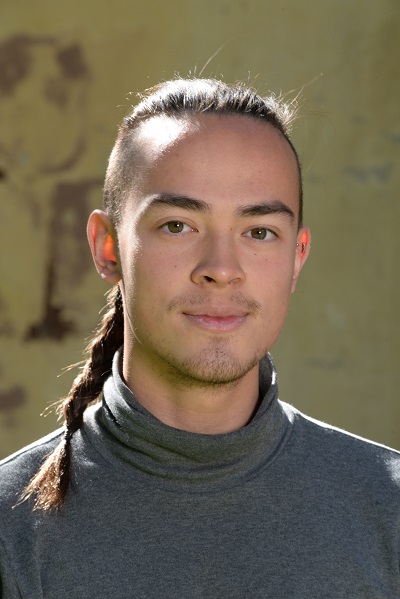
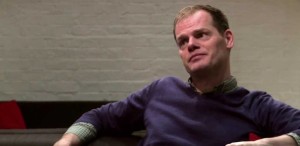
Tristan Carter, dancer of the Kibbutz Contemporary Dance Company
What ”color” are you bringing into the company’s fabric?
I’m coming from far away, the southern hemisphere, and have been trained in floor work. In KCDC we have a daily ballet training, different from what we bring to the stage. When I joined the company,thisbig shift was really challenging, I had done ballet for just a year when I was 17.But I think my training has given me a particular set of skills, more ballistic kind of movements. When I met Rami I was very young, I was 20, and he said my potential lies in the fact that I was ”very unpolished”. So he gave me the time, which is amazing, not many big companies would do that.
How is living and doing artistic working in the kibbutz like?
The kibbutz in itself is very beautiful, it’s in Galillee so it is greener than the rest of Israel. Very quiet and village-like, there is a cafe, a place where you can buy ready-made food, a small convenience store, and we all live in these beautiful houses. So everything is really close, for me it takes 45 secondsof walking from home to work. At the same time it’s not so isolated, it’sless than two hours by train from Tel Aviv. Every weekend I travel somewhere.
What I love about the kibbutz is that it is a very unique situation. To live and work there, feeling the cultural heritage of this company, the story behind the kibbutz… We also tour a lot, which makes for a beautiful contrast between the life in that village-bubble and travelling all over.
How does this „bubble life” impact the dancer’s training?
It saturates the work environment very much. There isn’t a ”different world” to go to. When we leave work, we actually go 30 seconds away. This situation, I believe, gives a lot of space to creation; a lot of the time, when we’re creating a new piece, after work we go to the studios to work some more, because the studio is right there and also there’s no other distraction.
Is this ideal, or does it get much?
I think it’s a completely personal preference. It’s really unique, I don’t know of any other company that works like this. There are people who come to the company, last for 3 years maybe, then can’t take it anymore and leave, and then there’s also people who may stay for 11-12 years because the situation really works for them.
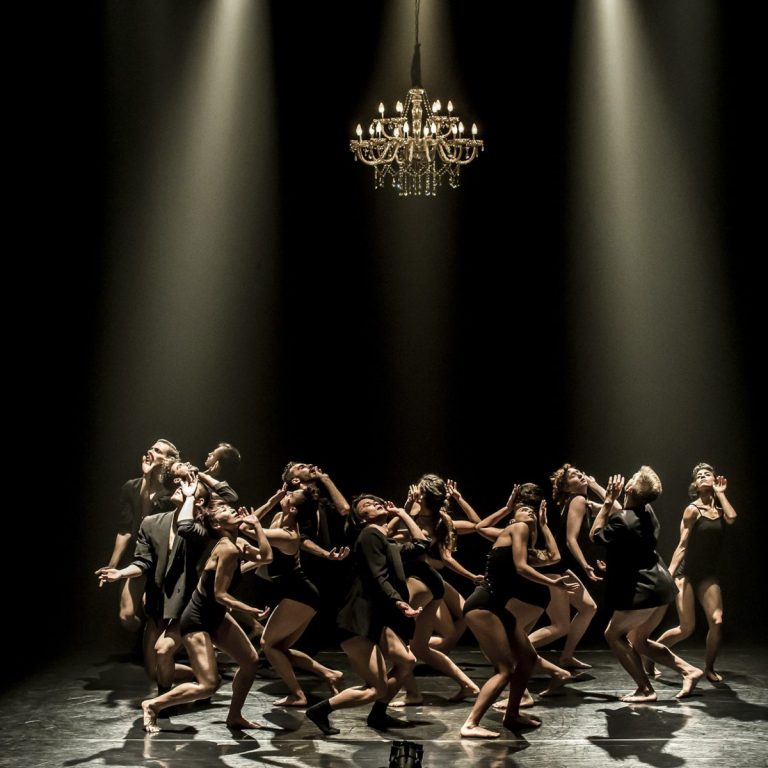
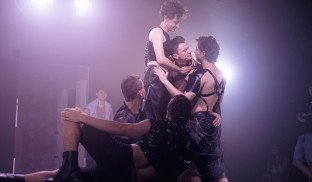
Image from Mother’s Milk, choreographed by Rami Be’er
What kind of creator is choreographer Rami Be’er?
He is very free and trusting. Totally not a choreographer who will dictate a movement. He sometimes improvises and asks us to build material from that. He really values the individuality of each of us and what he saw in one in the first place – that’s what he wants from you, that’s why he chose you, not because you have amazing legs that can replicate Swan Lake or something like that. We create ourselves a lot too, and then Rami crafts things like a sculptor with clay.
How did you experience Mother’s Milk?
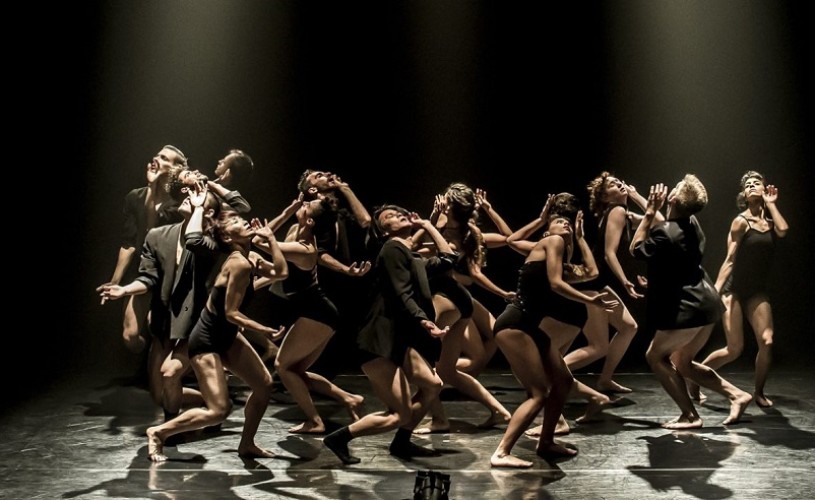
I joined the show later, but it obviouslyis a very personal one for Rami, which also brought added pressure. He is very sensitive about this piece, due to the connection with his parents. With other shows, the huge heritage of the kibbutz and also a very high level of physicality are more ”in your face”.Here, there is the elegant chandelier, everything is black, a lot of minimal movements in the group sections, the music has a lot of strings and kind of romantic sounds, with classical music too… The mood is more emotional, and the whole show is a quite calm and internal one.
Continuing their current tour, the Kibbutz Contemporary Dance Company will be presenting „Mother’s Milk” in Paris (France), Tivat (Montenegro), Herzliyah (Israel) and Lodz (Poland).
Watch Mother’s Milk trailer
(Pentru varianta în limba română, aici)
Photos: Sibfest 2018, KCDC